
Dr. Robin Davidson has had a long and inspiring career as a poet. She is the author of two chapbooks, Kneeling in the Dojo (Finishing Line Press, 2013) and City That Ripens on the Tree of the World (Calypso Editions, 2013), as well as the collection Luminous Others, awarded the Ashland Poetry Press’ Richard Snyder Memorial Prize. In her latest collection, Mrs. Schmetterling (Arrowsmith Press), Dr. Robin Davidson gives voice to the inner workings of the mature woman contemplating life choices, experiences, motherhood, nature, and the world around her. Davidson’s poems are in conversation with the artworks of Sarah Fisher. I met with Dr. Davidson on October 7, 2025, to discuss this collection at a small coffee shop in Houston, Texas. This interview has been edited for clarity and brevity.
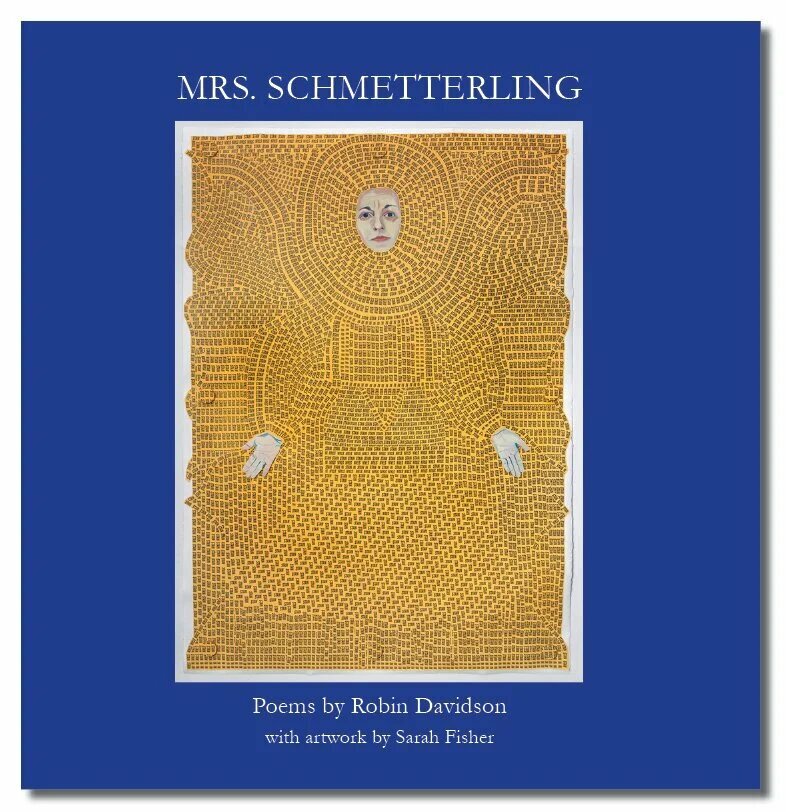
Christy Marie Cobb: Mrs. Schmetterling is the persona in the poems in your new collection. Has Mrs. Schmetterling been around a while?
Dr. Robin Davidson: She has been. When I was in graduate school, Polish poet and essayist Adam Zagajewski was my dissertation director. I did my oral exams on Ewa Lipska’s poems.
After that, Adam said, I wrote to Ewa and asked her to send you a book. It was the year 2000, and the book had just been published. He gave it to me; I was so excited. It was in Polish. I couldn’t read a thing. I really wanted to learn to read Polish. I wanted to read her books and books by her mentor, Szymborska. I applied for and received the Fulbright. I received a professorship at Jagiellonian University, at the University of Kraków. I studied Polish with a teacher at the American Consulate. Ewa published another book called Dear Ms. Schubert. I loved those books and wanted to translate them into English. She helped me find a co-translator in Poland.
We began to translate the work. I loved Ms. Schubert, and I began to write in response to her. I developed a correspondence with my persona I call Mrs. Schmetterling.
CMC: Did you take the poems from the older collection and put them in with the newer collection?
RD: Yes. some. Most are all new. Much newer. For seven or eight years, I have been living with this character and in conversation with her for a while.
CMC: What is Mrs. Schmetterling’s relationship to women in general?
RD: She was the permission that I needed first to speak frankly about my womanhood. Then, I would say that she really does extend to other women’s experiences.
Ewa wanted Schubert to be a European sort of every woman. She wanted the title to be translated to Ms. Schubert, not Mrs. Schubert. I had people tell me that I should have Mrs. Schmetterling be Ms. Schmetterling, but that is not who she is. This is a woman who is defined by a patriarchal nation and patriarchal relationships where you are less important. At least in White Anglo culture, if you did not have a male representative, women were ignored. Men were always deferred to. This is a woman who struggles with those constraints.
CMC: She is the representative of those women who struggled with the fact that they needed the Mrs. to be recognized.
RD: Yes. Mrs. Schmetterling is a woman who can think. She is married. She has had children. She is a grandmother. She has participated in the culture. She is at the point in her life when she is reflecting on the way that culture has both shaped and limited her.
CMC: As you read, you get the sense of longing for the dreams she has lost along the way. Not that she isn’t grateful for the life she has, but the longing for a life that could have been.
RD: Absolutely.
CMC: How did the book and the artwork come together? I have to say this is a gorgeous book.
RD: Kevin Prufer organized a reading in Montrose. Before the reading, I saw this image on the wall. I was fascinated. I thought, “Oh my God, that is Mrs. Schmetterling!” I just felt it. Kevin sent me a picture of the piece and texted it to me. I saved it for three or four years. In 2020, I started thinking about Mrs. Schmetterling again. I had kept the picture. I looked the artist up and contacted her. I asked if I could use this image.
In the meantime, Askold Melnyczuk, in spring 2021, who is the editor at the press that published the collection, Arrowsmith Press, reached out and said they needed a short manuscript. They had published three books. They usually publish four at a time. He asked if I had anything. I said, yes. I had a chapbook that I had only just finished. I sent it to him. He wrote me back that night and said he liked these poems and would take it.
I have never had that easy an experience. I work with this wonderful guy, Ezra Fox! This man is a genius! We contacted Sarah to ask to use more images. She agreed. He matched up all the images with my poems. Sarah and I made a few changes, but this book is very much his, too.
CMC: What is your favorite poem in the collection?
RD: “In the Balance of Final Things.” I like reading that poem. I feel like it is honest. We are born into a very particular thing, a very particular country, city, skin, body, and everything. You can associate them with class. It seems predetermined by other factors. I have had a fortunate life. I was not born in the middle of World War II. I was not born in Ukraine or Bosnia. It was a very white, middle-class family upbringing without war in this country. I have been to Europe without war in Europe. This poem really acknowledges the randomness of things. I mean, I just feel grateful for the privileges that I have had, completely unarranged by me.
CMC: How do you maintain longevity in a poetry career? You have been doing this now for 45 years.
RD: Have value in yourself and your work. This is something I have not done. I always feel like someone else’s needs are more important than my own. Someone else’s poetry is always better than my own. Whatever it is that you love that you can do, want to do, and are good at, do it. Don’t let other things stand in the way of that. At least some of the time, be self-centered. To maintain longevity, you have to have some belief in yourself, and I struggle with that. Poetry just saves me over and over again.
CMC: What is your creative process?
RD: I used to take walks all the time. So many of these poems began their formation on a walk. I have an idea. I want to write a long poem. One long poem in sections, with images that I do in collage. I am going to do collages based on the sections. So, I have been walking, often on the treadmill in the gym. I walk for fifteen minutes, maybe twenty minutes, and boom, I get a whole section. In my mind. Then, I have to go home and pull out my little notebook and just take notes. Today, I walked for about seventeen minutes, and I have another section; this long poem is just happening. It is an auditory experience. I attribute some of that to the Episcopal Church. You know, hearing the liturgy and the Bible. Hearing the beautiful language.
CMC: Poetry is akin to the church experience for you. Is poetry spiritual for you?
Dr. Robin Davidson: Poetry is like praying. Poetry is spiritual because it is transcendent. It is an encounter with something larger than us. We can experience that in nature, too—these moments of awe that take us beyond the smallness of our own lives and connect us with others, the world, the universe, and the divine. ◆


